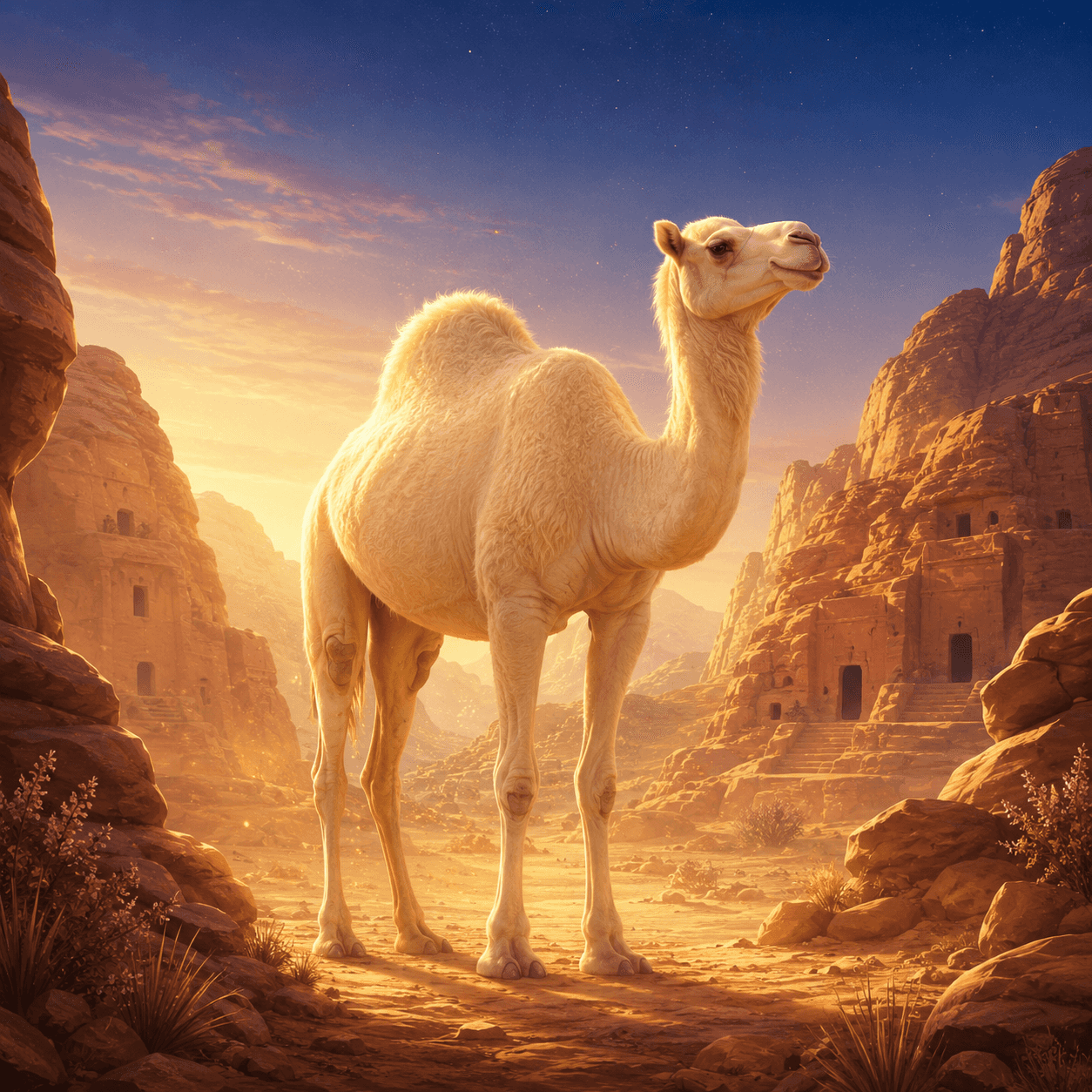
Prophet Salihصالح
Also written: Saleh, Prophet Saleh, Salih and the she-camel, Thamud
Prophet Salih, peace be upon him, was a prophet of Allah sent to the people of Thamud, skilled builders who carved their homes into the rock of northern Arabia. When they demanded a sign, Allah sent a she-camel as a miracle and commanded them not to harm her. They killed her and rejected his warning, and were destroyed, while Salih and the believers were saved (Surah al-A’raf 7:73-79).
Free to start. The full narrated story, with soundscapes and a sleep timer, is in the app; the complete text is below.
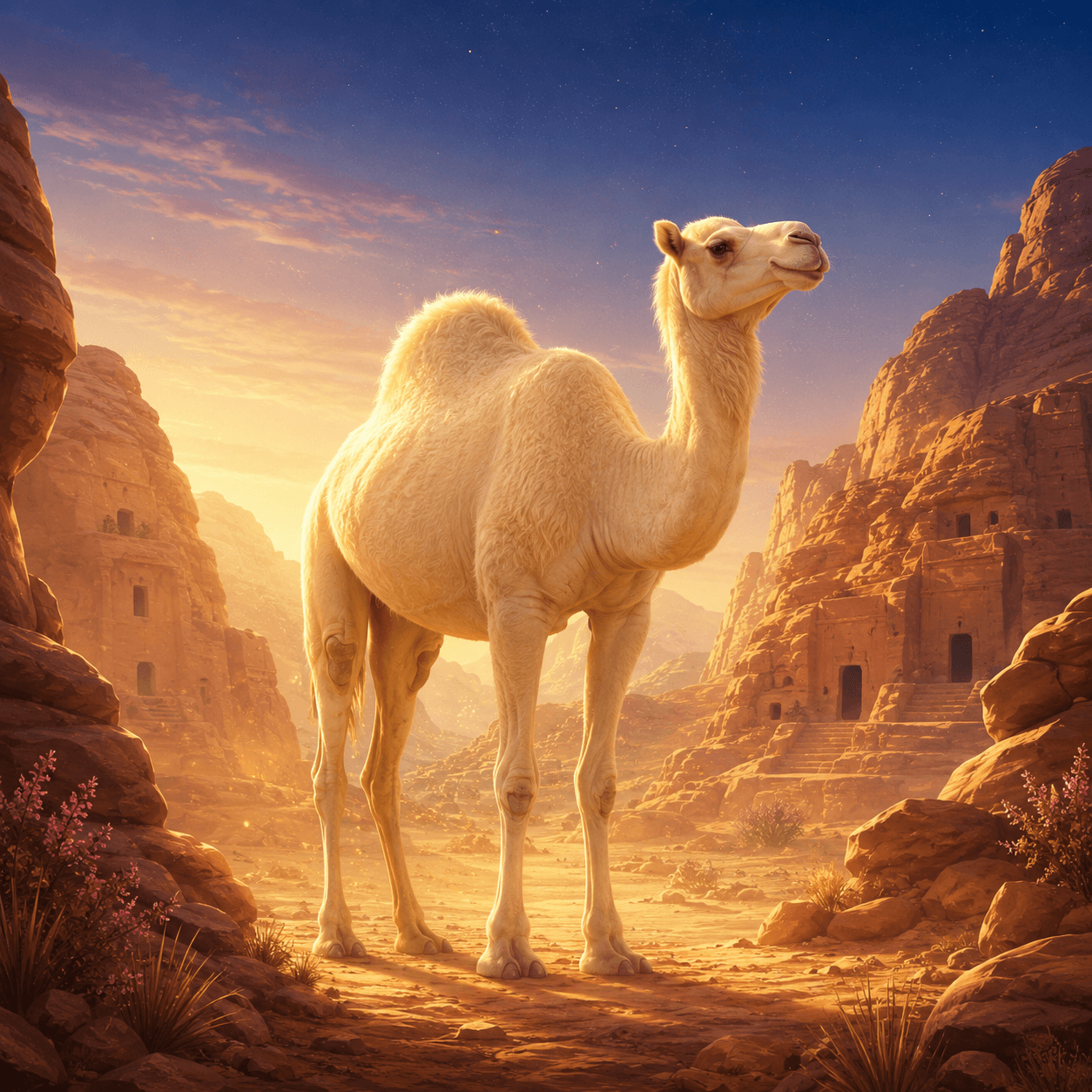
“This is the she-camel of Allah, a sign for you.”
Who was Prophet Salih?
Prophet Salih, peace be upon him, was sent to Thamud, a people of the red-rock valleys of northern Arabia (in what is now Saudi Arabia) who carved their houses into the mountains with great skill (Surah al-A’raf 7:74). Allah had given them gardens, springs, and strength, but instead of gratitude they grew proud and worshipped idols they had carved themselves. Allah sent them a prophet from among their own people, a man they had trusted and had high hopes for (Surah Hud 11:62). Salih told them plainly: “O my people, worship Allah; you have no god other than Him” (7:73). The weak and the poor believed him; the proud chiefs refused and demanded a sign (7:75-76).
Allah gave them the she-camel of Allah as a sign (7:73). Classical tafsir (Ibn Kathir) relates that she came out of solid rock before their eyes. The command was simple: let her graze freely in Allah’s earth and do not touch her with harm (7:73, Hud 11:64). The water of the valley was to be shared by turns, one day for her and one day for the people (Surah ash-Shu’ara 26:155, Surah al-Qamar 54:28), and the tafsir adds that on her day she gave milk enough for the town. The test asked only for kindness to an animal and fair turns.
The proudest men could not bear the sign that proved Salih right, and they hamstrung and killed the she-camel (7:77, Surah ash-Shams 91:14). Salih, grieving for his people, told them: “Enjoy yourselves in your homes for three days; that is a promise not to be belied” (Hud 11:65). When the three days passed, the punishment Allah had promised seized the wrongdoers, and they lay lifeless in their homes (7:78). But Allah saved Salih and those who believed with him by a mercy from Him (Hud 11:66). Surah ash-Shams recalls the whole story in five short verses (91:11-15).
The story of Prophet Salih, told for children
The complete text of every Prophet Salih story in Sukun Kids. Sources: the Qur’an (Surah al-A'raf · 7:73), Ibn Kathir’s Stories of the Prophets, and Ma’ariful Qur’an; the seerah and hadith for the companions. Read it aloud tonight, or press play in the app and let the narration carry it. How the stories are reviewed →
Prophet Salih16 min listen
+
Come with me. Today, we're going on a journey... far, far away... and long, long ago.
Picture a mountain. A huge one, bare rock, reddish-gold, standing under a wide empty sky.
A crowd of people is gathered at the bottom of it. Hundreds of them. They are standing very still, arms folded, waiting. Some of them are smiling the way people smile when they think somebody is about to fail.
And one man stands in front of them all, with his hands open, praying.
Then the mountain moves.
Not the whole mountain, one part of it. The solid rock shivers. It cracks. It opens, the way a door opens... and out of the middle of the stone...
...walks a camel.
A living camel. Enormous. Calm. Blinking in the sunlight. Walking out of solid rock as though she had simply been waiting in there all along.
And the whole crowd goes completely silent.
This is the story of Prophet Salih... alayhi salaam... and the she-camel of Allah.
Long, long ago... in a land of red rock and desert valleys, a place in the north of what we now call Saudi Arabia, there lived a people called Thamud.
And the people of Thamud were clever. Really, genuinely clever.
They were the best builders anyone had ever seen. They did not just build houses out of bricks like everybody else. They took their tools... and they walked up to the mountains... and they *carved their homes right into the rock*.
Imagine that. Great doorways cut into a cliff. Rooms hollowed out of solid stone. Beautiful carved pillars, right there in the mountainside. Cool in the summer. Warm in the winter. Strong enough to last for hundreds and hundreds of years.
Allah had given them so much. Good land. Gardens. Springs of fresh water. Date palms heavy with fruit. Strength in their arms and cleverness in their hands.
But here is what happened to their hearts.
They looked at everything they had... and instead of saying *thank You, Allah*... they said *look what we did.*
They became proud. And they stopped worshipping Allah, and started worshipping statues they had carved themselves, with the very same hands and the very same tools.
Statues that could not see them. Could not hear them. Could not help them with anything at all.
So Allah sent them a prophet.
And He did not send a stranger. He sent one of their own people, a man they had known since he was a boy. A man they trusted. His name was Salih.
Before Salih ever said a word about Allah, the people of Thamud already liked him. He was honest. He was thoughtful. They used to say he was one of the best among them, and they had big hopes for him.
Then Salih stood up in front of them and said the thing Allah sent him to say:
"O my people... worship Allah. You have no god other than Him."
He reminded them of everything. *Look at your gardens. Look at your springs. Look at these homes you carved so beautifully into the mountains. Who gave you the land? Who gave you the water? Who gave you the strength in your arms and the cleverness in your hands?*
*All of it is from Allah. So be grateful to Him. And worship Him alone.*
And a few of them listened. Mostly the ones who did not have very much, the poor, and the ones nobody important paid attention to. They heard Salih, and they believed.
But the chiefs, the proud, powerful, wealthy men at the top, folded their arms and said no.
"Salih," they said, "we used to have such hopes for you. And now you tell us to leave what our fathers worshipped?"
Then they said: "If you really are a prophet... bring us a sign."
And that is how everyone ended up standing at the foot of that mountain.
The people had chosen the sign themselves. They pointed at the solid rock and said: bring us a camel out of *that*.
So Salih prayed to Allah. And Allah, who made the mountains in the first place, split the rock open.
And the she-camel came out.
She was a wonder. Everybody could see it. There was nothing ordinary about her at all.
And Salih turned to his people and said:
"This is the she-camel of Allah, a sign for you."
"So let her eat freely in Allah's earth. And do not touch her with any harm."
That was it. That was the whole rule. Two simple things. *Let her eat. Do not hurt her.*
And there was one more arrangement, because water was precious in that dry land. Allah told them the water would be shared, turn and turn about. One day, the she-camel would drink. The next day, all the people would drink.
A fair share. A day for her, a day for them.
And here is the part people forget.
On the day the she-camel drank... she gave milk.
Not a little. Not a cupful. She gave milk for the whole town.
Everybody came out with their bowls and their jars and their buckets. The old people. The families. The children. And every single person who came... went home with enough.
Imagine that. She drank their water for one day... and she fed all of them in return.
So she was not a burden. She was not something they had to put up with. She was a *gift*. Walking around their valley, quietly giving them more than she ever took.
That is how Allah's signs usually are, if you look properly. They do not just prove something. They *give* you something at the same time.
Now think about how gentle this test was. Allah could have asked them to do something enormous and difficult. Instead He asked them to be *kind to an animal*, and to *take turns*.
That was all.
For a while... it worked.
The she-camel wandered the valley. She grazed. She drank on her day. The people drank on theirs.
But the proud chiefs could not stand it.
Every time they saw her, they saw the thing that proved Salih was telling the truth. Every time she drank, they had to wait. And their pride burned and burned.
So a group of the worst among them made a wicked plan. And one day... they went out... and they harmed her. They killed the she-camel of Allah.
The sign that had walked out of a mountain, the gentle animal who had never done a single thing to anybody, was gone.
And then they turned to Salih, still proud, and said: *bring on whatever you were warning us about.*
Salih's heart broke for them. Not for himself. For them.
He said: "Enjoy yourselves in your homes for three days. That is a promise that will not be broken."
Three days. Allah gave them three whole days, not to be frightened, but to think. Three days to say *we were wrong*. Three days to come back. Allah is so patient. He always leaves the door open.
But they did not come back.
And when the three days had passed... Allah's promise came true, exactly as He said it would.
The wrongdoers were seized, and their carved stone houses stood empty in the morning.
All those beautiful rooms cut into the mountain. All that clever work. Standing there in the desert, silent.
But listen, because this is the part that matters most.
Allah saved Salih. And Allah saved every single person who had believed with him.
The Qur'an says it plainly: *We saved Salih and those who believed with him, by a mercy from Us.*
The poor ones nobody listened to. The quiet ones the chiefs looked down on. Every single one of them, safe. Because Allah does not measure people the way people measure people.
That is the story of Prophet Salih, alayhi salaam. A man Allah sent to his own people, who prayed at the foot of a mountain until the rock opened and a camel walked out. Who asked his people for the simplest thing in the world, be kind, and take turns, and who was saved, along with everyone who believed, by the mercy of Allah.
And now... slowly... we leave the red rock valley behind... the carved doorways in the cliffs, the date palms, the wide desert sky... and we travel back home. To right here. Right now.
But carry Prophet Salih with you, wherever you go. Because his story leaves us two small, gentle things to hold on to.
The first: be kind to animals. Every creature Allah made belongs to Him. The way you treat a cat, a bird, a beetle on the path, Allah sees all of it.
And the second: whenever something good comes to you, a clever idea, a strong pair of hands, a beautiful thing you made, remember who gave it to you. Say *alhamdulillah*. That one little word is the whole difference between the people of Thamud... and the people who were saved.
So let us end with Prophet Salih's own words to his people. They mean... O my people, worship Allah; you have no god other than Him. Say them with me... slowly...
*Yā qawmi-ʿbudū-llāha... mā lakum min ilāhin ghayruh.*
The Camel from the Rock6 min listen
+
Come with me. Today, we're going on a journey... far, far away... and long, long ago.
We're going to a wide desert valley of red and gold rock... in the bright middle of the day... with the sun straight overhead.
And here we are. Feel that? Warm stone under your feet. Dry air that catches in your throat a little. Put your hand on the rock beside you, it is hot, and rough, and completely solid. Nothing in the world is more solid than a mountain.
Now look around. There are hundreds of people gathered here. Standing very still. Arms folded. Waiting.
They are the people of Thamud, and they are clever people, the best builders anybody has ever seen. Look up at those cliffs. See those great carved doorways cut straight into the mountainside? Those are their houses. They carved them out of solid rock with their own hands.
And some of them are smiling right now. Not kind smiles. The sort of smile people wear when they think somebody is about to fail in front of everybody.
Because standing in front of them all is one man, with his hands lifted, praying.
That is Prophet Salih, alayhi salaam.
Allah sent him to these people, and He did not send a stranger. Salih grew up here. They had known him since he was a boy. They used to say he was the best among them.
But when he told them to worship Allah alone and leave the statues they had carved... the proud ones folded their arms and said: *prove it. Bring us a sign.*
And they chose the sign themselves. They pointed at the mountain, that mountain, right there, the hardest thing for miles, and they said: *bring us a camel out of that.*
So keep one little word safe in your pocket... *solid*. Hold on to it. It is about to stop being true.
Salih prays.
And the mountain... moves.
Not all of it. One part. The rock shivers, the way water shivers when you touch it. Then a crack runs down it, a sound like nothing you have ever heard.
And the stone opens. The way a door opens.
And out of the middle of it...
...walks a camel.
A real, living, breathing camel. Enormous. Completely calm. Blinking in the bright sunlight, and shaking the dust off herself, as though she had simply been waiting in there all along for somebody to open the door.
And every single person in that valley goes silent.
Hundreds of people. Not one word between them.
Because the hardest thing they knew, the solid rock they had spent their whole lives carving with iron tools, had just opened like a curtain, because Allah told it to.
And Salih turns to them and says: "This is the she-camel of Allah, a sign for you."
Here is what this moment whispers to us. Nothing is solid to Allah.
Not mountains. Not problems. Not the things in your life that feel completely stuck and impossible to move. Allah made the rock in the first place, and when He says *open*, it opens.
I wonder what feels like solid stone in your life right now... and how easily Allah could open it.
And now... softly... we step back from the hot bright valley... away from the silent crowd and the calm, blinking camel... and home. To right here. Right now.
And we can carry Prophet Salih's own words with us. They mean... O my people, worship Allah; you have no god other than Him. Say them slowly...
*Yā qawmi-ʿbudū-llāh... mā lakum min ilāhin ghayruh.*
A Day for Her, a Day for You6 min listen
+
Come with me. Today, we're going on a journey... far, far away... and long, long ago.
We're going to a desert valley of red rock... early in the morning... when the shadows are still long and cool.
And here we are. Listen. Do you hear that? Buckets. Jars. Bowls knocking gently together. Lots of feet on stone.
The whole town is coming out.
This is where the people of Thamud live, the clever people who carved their houses into the mountains. And this morning, they are all walking toward the well in the middle of the valley.
But they are not here for water.
Because today is not their water day.
Let me explain. Something amazing happened here not long ago. Allah brought a she-camel out of the solid rock, as a sign, in front of everybody. And Prophet Salih, alayhi salaam, told his people the rules that came with her, and there were only two.
*Let her eat freely in Allah's earth.*
*And do not touch her with any harm.*
That was it. That was the whole test. Be kind to an animal.
And because water was so precious in that dry place, Allah set up one more thing. The water would be shared. Turn and turn about. One day for the she-camel to drink. The next day for all the people.
A fair share. Her turn, then theirs.
And today is her turn. So why is everybody out here with bowls?
Watch.
The she-camel comes down the valley, slow and calm, the way she always does. She drinks. Deeply. For a long time.
And then... she gives milk.
Not a little. Not a cupful.
Enough for everybody.
The whole town lines up. The old people. The families. The children with their small bowls held out in both hands. And every single person who comes... goes home with enough.
Do you see what is actually happening here?
She drank their water for one day... and she fed all of them in return.
She was not a burden. She was not a nuisance they had to put up with because a prophet said so. She was a *gift*, walking around their valley, quietly giving them far more than she ever took.
That is how Allah's signs usually are, if you look properly. They do not only prove something. They *give* you something at the same time.
Here is what this moment whispers to us. Taking turns is not a small thing. It looks small, waiting your turn with the toy, waiting your turn to speak, letting someone else go first, but Allah made a whole nation's test out of exactly that.
And being kind to animals is not a small thing either. Every creature belongs to Allah. The way you treat a cat, or a bird, or a beetle crossing the path, Allah sees all of it.
I wonder whose turn it is tomorrow... that you could let them have without arguing.
And now... softly... we step back from the well and the bowls and the tall calm camel... out of the long cool shadows... and home. To right here. Right now.
And we can carry the rule Allah gave them with us. It means... this is the she-camel of Allah, a sign for you. Say it slowly... and remember what it asked of them...
*Hādhihi nāqatu-llāhi lakum āyah.*
Three Days to Come Back6 min listen
+
Come with me. Today, we're going on a journey... far, far away... and long, long ago.
We're going to a desert valley of red rock... late in the afternoon... when the light has turned heavy and gold and everything casts a long shadow.
And here we are. Something has just happened here. You can feel it in the air. It is too quiet.
For a long while, life in this valley had been good. The people of Thamud had their carved stone houses and their gardens and their springs. And they had a she-camel, a sign from Allah, brought out of the mountain in front of everybody, who drank on her day, and gave milk to the whole town, and never hurt a soul.
Two rules. Let her eat. Do not harm her.
But some of the proudest men in that town could not stand her.
Every time they saw her, they saw the thing that proved Salih was right. And their pride burned and burned... until one day they went out and harmed her.
She is gone.
The gentle animal who had never done anything to anybody. The gift that fed their children. Gone.
And now those men are standing in front of Prophet Salih, alayhi salaam, with their chins up, and they are saying: *go on then. Bring on whatever you were warning us about.*
Now watch Salih's face.
He is not angry for himself. He is not thinking *I told you so*.
His heart is breaking. For *them*.
These are his people. He grew up here. He knows their names, and their parents' names. He has spent years trying to get them to listen, because he did not want anything bad to ever happen to them.
And he says this:
"Enjoy yourselves in your homes... for three days."
"That is a promise that will not be broken."
Three days.
Now I want you to think very carefully about those three days. Because they are not what they sound like.
They are not a countdown. They are not Allah being dramatic.
They are a *door*.
Three whole days, left wide open. Three days to think. Three days to look at what they had done and feel it properly. Three days to say the two hardest words in the world, *we're sorry*, and turn back to Allah.
Allah did not have to give them a single hour. He gave them three days.
That is how patient Allah is. Even with people who had done something that terrible. Even at the very last moment. The door stays open, and open, and open.
And they had three days to walk through it.
Here is what this moment whispers to us. Allah always leaves the door open.
However badly a day has gone. However much you wish you could take something back. However long you have been meaning to fix it and never quite have. You can turn around, any time, and Allah is not standing there with His arms folded. He is glad you came.
The only sad part of this story is that nobody walked through.
I wonder if there is something small you have been meaning to say sorry for... that you could say tonight, before you sleep.
And now... softly... we step back out of that long gold afternoon... away from the quiet valley and the man whose heart is breaking for his own people... and home. To right here. Right now.
And we can carry the words we say when we turn back to Allah. They mean... I seek the forgiveness of Allah, and I turn to Him. Say them slowly...
*Astaghfiru-llāha... wa atūbu ilayh.*
The Ones Who Were Saved6 min listen
+
Come with me. Today, we're going on a journey... far, far away... and long, long ago.
We're going to a desert valley of red rock... at first light... on the quietest morning that valley has ever had.
And here we are. Feel how cool the air is before the sun comes up properly. Look at the cliffs going pink at the top.
And look at the houses. All those beautiful doorways carved into the mountainside. All that clever work, done by the best builders anybody had ever seen.
They are empty now.
The people of Thamud were given every chance. A prophet from among their own people. A sign brought out of solid rock. Two gentle rules, be kind to an animal, and take turns. And when they broke them, three whole days to come back.
They did not come back. And in the end, Allah's promise came true, exactly as He said it would.
But that is not why I brought you here this morning.
I brought you here because of a group of people walking away down the valley, in the early light, alive and safe.
Look at them.
There is Prophet Salih, alayhi salaam, at the front. And all around him, walking with him, carrying their bundles, holding their children's hands, are the people who believed.
Now I want you to notice something about them.
They are not the important ones.
Back when Salih first started teaching, the Qur'an tells us exactly who listened. It was the ones nobody thought much of. The poor. The weak. The ones the proud chiefs looked straight past. The people who did not have carved houses in the best part of the cliff.
The chiefs used to sneer at them. *You? You're the ones who believe him?*
And now, on this quiet morning, every single one of those people is walking down this valley, safe.
The Qur'an says it plainly: *We saved Salih, and those who believed with him... by a mercy from Us.*
By a mercy from Us.
Not because they were strong. Not because they were rich or clever or important. Because Allah was merciful to them, and because they had believed when believing was the unpopular thing to do.
Here is what this moment whispers to us. Allah does not count people the way people count people.
People count money, and loudness, and who has the biggest house, and who everybody laughs at. Allah does not.
Allah looks straight at your heart. And a person nobody notices at all, a quiet person, a small person, somebody who never once got picked first for anything, can be one of the most precious people in the whole world to Allah.
So if you have ever felt small, or left out, or like you are not one of the important ones... remember who walked out of that valley alive.
I wonder who is quiet and easy to overlook in your class or your street... and whether you might be the one who notices them tomorrow.
And now... softly... we step back from that pink and quiet morning... away from the empty doorways and the small brave group walking down the valley... and home. To right here. Right now.
And we can carry Allah's own words about them with us. They mean... We saved him and those who believed with him, by a mercy from Us. Say them slowly...
*Najjaynāhu wa-lladhīna āmanū maʿahu... bi-raḥmatin minnā.*
What children learn from Prophet Salih
Kindness to animals
Allah made a whole nation’s test out of not harming one she-camel; every creature belongs to Him.
Gratitude, not pride
Thamud said “look what we did” instead of “alhamdulillah,” and forgot the One who gave them everything.
Allah sees the overlooked
The poor and weak who believed were the ones saved, because Allah measures hearts, not status.
Questions about Prophet Salih
Who was Prophet Salih?+
Salih, peace be upon him, was a prophet of Allah sent to the people of Thamud in northern Arabia. He called them to worship Allah alone, and Allah gave them a she-camel as a sign. His story is told in Surah al-A’raf (7:73-79), Surah Hud (11:61-68), and Surah ash-Shu’ara (26:141-159).
What is the story of the she-camel of Salih?+
When Thamud demanded a sign, Allah sent a she-camel and commanded them to let her graze and not harm her, sharing the water by turns (Surah al-A’raf 7:73, ash-Shu’ara 26:155). The proud among them killed her, Salih gave them three days, and the punishment then came (Hud 11:65-67).
Who were the people of Thamud?+
Thamud were an ancient Arab people who lived in the rocky valleys of northern Arabia and carved their homes into the mountains (Surah al-A’raf 7:74, Surah al-Fajr 89:9). They were skilled and prosperous but grew proud, worshipped idols, and rejected their prophet Salih, peace be upon him.
Is Prophet Salih mentioned in the Quran?+
Yes, many times. Salih and the she-camel appear in Surah al-A’raf 7:73-79, Surah Hud 11:61-68, Surah ash-Shu’ara 26:141-159, Surah al-Qamar 54:23-31, and Surah ash-Shams 91:11-15, among others.
What can children learn from Prophet Salih?+
To be kind to animals, because every creature belongs to Allah; to take turns and share fairly; to say alhamdulillah for what they have instead of growing proud; and that Allah always leaves the door of repentance open, even for three more days.
Hear Prophet Salih's story narrated tonight.
Free to start in the Sukun Kids app, with soundscapes, a sleep timer, and a nightly quiz.